
Hunting Knife 11 Damascus Blade Stag Handle Free shipping in Continental US
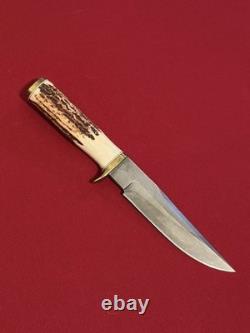
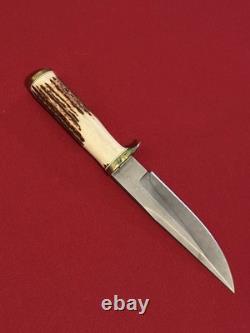
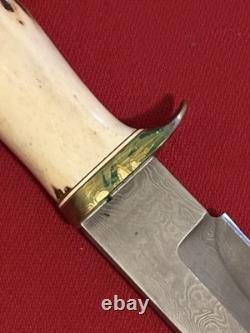
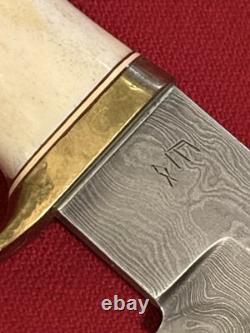
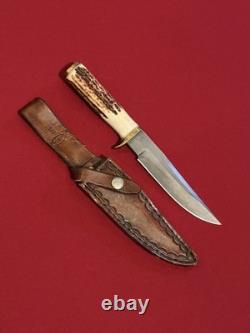
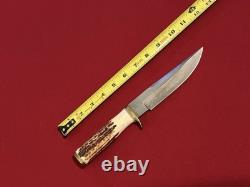

This is a fixed-blade hunting/skinning knife with a Damascus (pattern-welded) blade, stag handle, brass fittings, and a tooled leather sheath. It is a common style of semi-custom or production "handmade" knife, most often originating from Pakistani workshops (Sialkot area and similar) that specialize in these pieces. Key Features from the Photos. Blade: Drop-point (or slight clip-point) profile with a prominent Damascus pattern (wavy/random or ladder-style layers typical of pattern-welded 1095/15N20-style steel). Sharp-looking primary edge, polished flats, and a short false edge or spine detail near the tip. Maker's mark stamped near the ricasso. Handle: Stag antler (or high-quality stag-look material) with natural brown/black patterning. Brass/gold-colored bolster (with a thin contrasting copper or nickel line) and pommel cap. Single downward-curving finger guard/quill on one side.
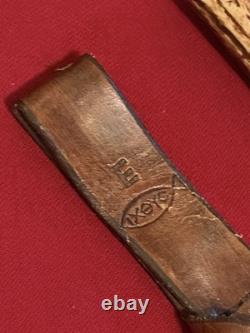
Overall size: Approximately 10.5-11 inches total (blade roughly 5.5-6 inches based on the tape measure photo). Sheath: Brown leather with tooled/scalloped edges, decorative stitching, snap closure, and belt loop. Stamped marks on the loop/strap area.
The construction (hidden or partial tang with bolsters, stag scales, brass fittings, and matching leather sheath) is typical of these knives. The Mark on the Blade ("XAT"). The stamped/engraved symbol near the handle is XAT. This is a maker's or workshop mark (initials or logo).
It does not appear to match any widely known, high-profile custom knifemaker in readily available references. On knives of this style it is most often the mark of the producing workshop or an importer's identifier rather than a famous individual smith. The Damascus pattern itself is almost certainly real pattern-welded steel rather than a laser-etched or printed imitation, though heat-treatment quality on these production pieces can vary.
The Symbol on the Sheath. The fish outline containing letters (IXOYC /????? -style) is the traditional Christian Ichthys (or Ichthus) symbol. The Greek word for "fish" is ichthys (????? It functions as an acrostic for Iesous Christos, Theou Yios, Soter - Jesus Christ, Son of God, Savior.Early Christians used the simple fish symbol as a discreet identifier; the version with the letters inside is a modern common form of the same symbol. The letters "EL" stamped above the fish are almost certainly the initials of the sheath maker (or an additional workshop mark). Sheath stamps do not always match the blade maker, as sheaths are frequently made separately or by subcontractors. Steel care: Pattern-welded Damascus of this type is usually high-carbon (or a carbon/nickel mix) and can rust if left wet or un-oiled. Wipe dry and lightly oil the blade after use.
Handle: Genuine stag benefits from occasional conditioning and should be kept reasonably dry. Use: Suitable for light-to-medium outdoor, camping, or skinning tasks.
For heavy batoning or hard use, many people prefer higher-end custom or production knives with documented heat treatment. In short: attractive, typical Pakistani-style Damascus hunting knife with a Christian Ichthys mark on the sheath and an "XAT" maker's stamp on the blade.
It is well-presented and functional for its category, but not a high-end named custom from a famous American or European smith. If you have more photos of the spine, the opposite side of the blade, or any paperwork that came with it, more precise details might be possible.